Reframing the Talent Scarcity Narrative in Indonesia’s Digital Transformation
Veda Praxis | May 21, 2026 | Strategy
As organizations race to recruit top talents to accelerate digital transformation, the narrative that Indonesia is facing a shortage of digital talent has taken hold. The fundamental question to ask then is whether the challenge truly lies in talent availability, or in organizations’ readiness to create environments that empower these digital talents.
In the digital economy, digital talent can no longer be treated as a supporting resource. Digital talent has become a new factor of production that directly shapes national competitiveness. Digital transformation, therefore, cannot succeed without a transformation of human capabilities.
This view is echoed by the Economic Research Institute for ASEAN and East Asia (ERIA) in its Working Paper No. 138, Strengthening Competitiveness in the Digital Economy: Implications for Indonesia, which states, “It puts emphasis on the need to make the workforce ready for the digital economy by equipping them with the relevant digital skills [1].” The strategic implication is clear. Productivity and innovation do not arise from technology alone, but from people who can translate technology into economic value.
This is where Indonesia’s paradox becomes apparent. Public discourse remains fixated on the idea of digital talent scarcity, while the deeper structural issue where many organizations are simply not ready to turn talent into value is often overlooked. A country may produce millions of digitally skilled workers, but without organizations capable of absorbing, developing, and retaining them, national competitiveness will remain constrained.

In reality, many strategic reports do not identify digital talent shortages as the primary barrier to Indonesia’s digital economic growth [2]. Growth in gross merchandise value (GMV), rapid e-commerce expansion, accelerating adoption of artificial intelligence (AI), and increasing monetization have all continued, even though talent supply issues rarely surface in macro-level analyses.
At the labor market level, competition for data, AI, and cloud roles is intensifying. These roles consistently rank among the most sought-after across digital employment reports. This signals that a lack of demand for talent is also not the core issue.
The absence of talent scarcity as a dominant theme in strategic studies does not mean that talent does not have significant value. Instead, it points to where the true bottleneck resides, which is within organizations themselves. The digital economy can scale in size, but it cannot advance in productivity without organizations that are capable of orchestrating data, technology, and human capabilities in an integrated manner. In short, Indonesia’s challenge is not a lack of digital talent, but a lack of digitally ready organizations.
Digital talent here refers to professionals responsible for managing data, digital products, platforms, automation, and AI, not merely end-users of technology. Meanwhile, digitally ready organizations are those with clear role definitions and accountability, explicit decision rights, engineering-driven and product-driven cultures that support disciplined experimentation, and active learning systems that enable capabilities to grow over time. Under this framework, the central question shifts from how many talents exist to how effectively organizations convert them into value.
The Indonesia Market Report published by the ASEAN– Australia Digital Trade Standards Initiative [3] highlights that Indonesia has entered a more complex phase of digitalization, marked by AI integration across supply chains and rising demand for digital trust amid increasing fraud and misinformation. Yet the report also underscores organizational readiness, rather than talent availability, as the core weakness.
Many companies have invested heavily in cloud infrastructure, analytics, and automation, but lack the role structures, digital governance, and managerial capacity required to translate these technologies into business outcomes. This reinforces Indonesia’s digital paradox. Digital talent is available, but the ecosystem required to support meaningful innovation is underdeveloped. As a result, talent has no room to create impact and ultimately seeks opportunities in organizations, industries, or countries that are better prepared for them.

Organizational Readiness as the True Bottleneck
A closer examination reveals that most challenges are grounded in one single issue, lack of organizational readiness. This manifests in outdated role structures, bureaucratic processes that slow iteration, and leadership that does not fully understand how digital work actually functions.
Research conducted by Center for Digital Innovation Studies (DIGITS) Universitas Padjadjaran and Veda Praxis across multiple industries in Indonesia supports this conclusion [4]. While awareness of digital governance, risk, and compliance has increased, execution continues to lag. Upskilling is often treated as an administrative exercise rather than a strategic investment. As a result, talent development stalls, innovation becomes inconsistent, and digital transformation is reduced to a technology project instead of a capability-driven shift.
Three findings from the study merit particular attention.
- Talent attraction and retention emerge as top strategic risks, not merely workforce risks. This implies that failure to manage talent is as critical as failure to manage financial or operational risks.
- The gap between awareness and readiness is substantial, implying that organizations know what must be done but lack internal mechanisms to execute.
- Digital leadership remains weak. Many managers do not understand how to map digital roles, manage data life cycles, or make risk-based decisions. It is therefore unsurprising that digital talent stagnates in organizations that provide no room for growth.
All these indicate that digital talent fails not because of a lack of competence, but because organizations fail to harness their competence.
Talent Outflow as a Symptom of an Unready Ecosystem
The increasing migration of Indonesian digital talent to Singapore and Malaysia further illustrates this point. Companies in these markets offer more mature technology environments, stronger learning opportunities, and clearer career pathways.
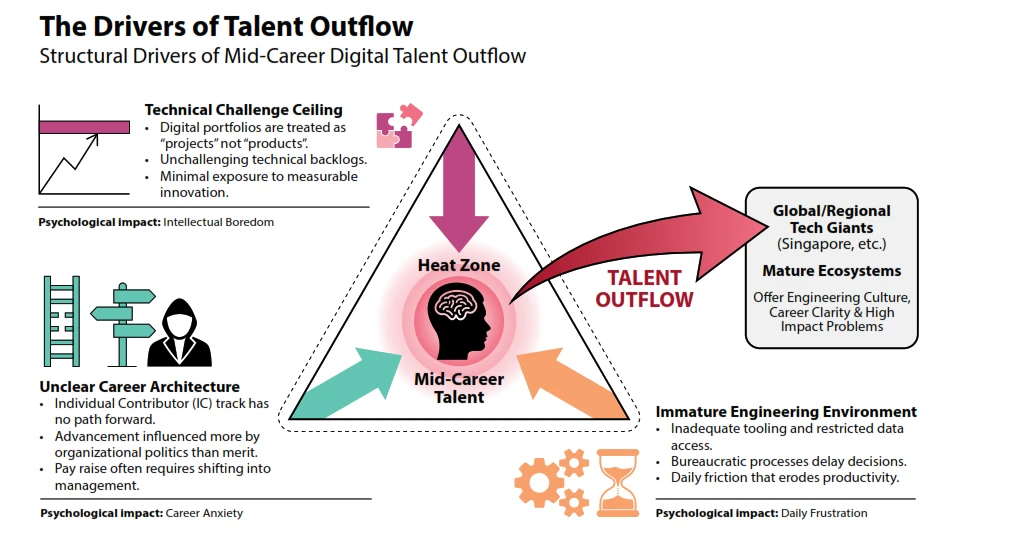
This movement is rarely driven by one single reason. Instead, it is typically triggered by a combination of three factors. The first is technical challenge ceiling, when talent encounters a lack of complex, high-impact problems because digital initiatives are not managed as products with clear backlogs and space for experimentation. The second is unclear career architecture, particularly the absence of well-defined individual contributor and managerial tracks, making career progression dependent on organizational politics rather than capability. The third is an underdeveloped engineering environment, encompassing tools, data access, governance, and decision-making speed, which creates daily friction and delays, even with a competent workforce.
These factors disproportionately affect mid-career digital professionals, who are highly sensitive to organizational quality. Research by the International Labour Organization (ILO) [5] and ERIA [6] shows that digital talent gravitates toward organizations offering technical challenge, adaptive structures, and leadership that understands technology. This reinforces the view that talent mobility is driven more by work environment and career clarity than by pay alone.
The absence of such conditions sends the message that other places are more ready to support the talent. Therefore, talent outflow is not evidence of a national talent shortage, but a signal that domestic organizations lack competitiveness as employers of choice.
Looking at this from a different angle, if Indonesia were truly short of digital talent, its e-commerce giants, technology startups, and unicorns would have struggled to survive. Instead, these sectors continue to grow despite intensifying global competition for talent. This reality demonstrates that organizations with modern systems are far better positioned to attract and retain digital professionals.
Building Organizations That Digital Talent Chooses
To become employers of choice for digital talent, organizations must strengthen three foundational pillars.
Structural Readiness
Traditional hierarchical models must give way to structures that support speed and cross-functional collaboration. This includes product-based organizational models, clear definition of digital roles such as data engineers, cloud architects, and MLOps specialists, and streamlined, non- bureaucratic decision rights. Structure shapes behavior, and misaligned structures inevitably constrain talent performance.
Capability-Building Systems
Training alone is no longer sufficient. Organizations must establish systems that enable continuous learning through apprenticeships, on-the-job learning, internal mobility, and exposure to complex technical challenges. A strong coaching culture is equally critical. Without a functioning internal capability-building engine, talent stagnation becomes unavoidable.
Digital Culture and Leadership
Faced with options, digital talent seeks environments that encourage experimentation and value new ideas. Just as importantly, they look for leaders who understand technology and risk, and who can translate data and AI adoption into clear value levers. When leadership fails to cultivate such a culture, organizations lose both talent and relevance.
A Necessary Shift in Perspective on the Development of Indonesian Digital Talent
Talent can no longer be treated as a purely human resources issue. It is now a matter of governance, strategy, and institutional readiness. From the national perspective, the issue of talent has direct implications for national competitiveness. Organizations that fail to manage digital talent risk falling multiple technology generations behind just within a decade. Those that succeed will become the gravitational centers of Indonesia’s digital economy.
For this reason, the narrative that Indonesia lacks digital talent demands critical re-examination. The more pressing issue may be that Indonesia lacks organizations that are prepared to nurture and elevate that talent.
Until this mindset shifts, Indonesian digital professionals will continue to seek ecosystems that recognize and accelerate their capabilities. The question, therefore, is no longer whether Indonesia can produce digital talent but whether its organizations are ready to support the growth of world-class talent.
References:
- “Strengthening Competitiveness in the Digital Economy: Implications for Indonesia,” ERIA, 2025
- Google, Temasek, Bain & Company, “e-Conomy SEA: Indonesia," 2025.
- ASEAN-Australia Digital Trade Standards Initiative, “Indonesia Market Report," 2023.
- DIGITS Unpad and Veda Praxis, “Manajemen Risiko Bisnis Tahun 2026: Dinamika, Strategi, dan Resiliensi Organisasi di Tengah Ketidakpastian,” 2025.
- ILO, “Skills shortages and labour migration in the field of information and communication technology in Canada, China, Germany, India, Indonesia, Singapore and Thailand,” 2020.
- M. Mahusin and H. Prilliadi, “Enhancing ASEAN’s Competitiveness: Strategies for Talent Mobility and Cooperation in the Digital Economy,” ERIA, 2025.