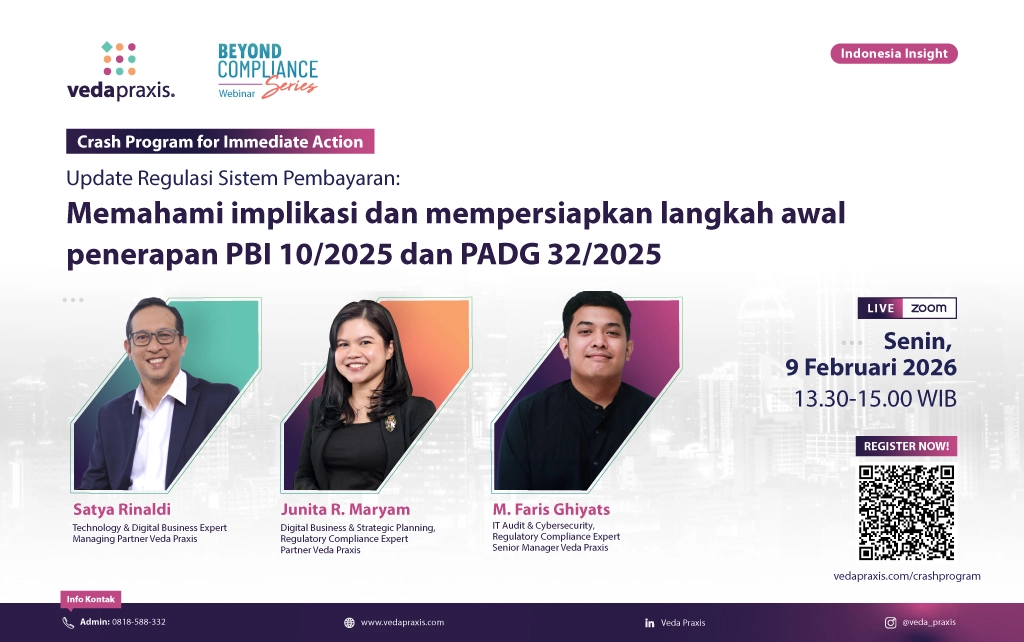
For years, compliance was often treated as a back-end administrative exercise: ensure the documents are complete, submit the required reports, avoid sanctions. With PBI No. 10/2025 and PADG No. 32/2025, Bank Indonesia has fundamentally changed that mindset.
These regulations do more than revise existing provisions. They signal a shift in regulatory philosophy, from a rule-based approach to one that is capability-based and risk-based. The central question is no longer “Are the rules being followed?” but "Is the institution genuinely prepared to carry out its role?"
Compliance, therefore, moves beyond formality. It becomes embedded in corporate strategy, business models, and growth plans. The scale and complexity of operations must be aligned with actual organizational capacity.
TIKMI as a Measure of Readiness
The TIKMI framework (Transactions, Interconnection, Competence, Risk Management, and IT Infrastructure) is not merely a supervisory checklist for regulators. It provides a structured lens for organizations to assess their readiness.
Under TIKMI, companies must ensure that:
- Transaction volume and complexity match their teams’ capability.
- Interconnectedness and partnerships are supported by sound risk governance.
- Technology infrastructure is sufficiently resilient to sustain growth.
This assessment is far from theoretical. Its results influence PSP classification, approval of the Payment System Business Plan (RBSP), and authorization for product development.
In practical terms, business direction is now determined by the capability demonstrated.
SBP and RBSP as a License to Operate
Within this framework, the Strategic Business Plan (SBP) and RBSP effectively function as a license to operate rather than a routine annual submission.
Without regulatory approval of these plans, expansion cannot proceed. Compliance must therefore be integrated into strategy from the outset. The compliance function should be involved in shaping direction instead of simply taking corrective actions at the final stage.
Compliance as a Positioning Strategy
With this shift, compliance strategy now shapes market positioning. Companies must deliberately determine:
- The targeted PSP category
- The activities they will prioritize
- The capabilities to build internally versus those to develop through partnerships
In this context, the cost of compliance is not limited to investments in structure, technology, or talent, but also involves opportunity cost. The greater risk lies not in meeting regulatory requirements, but in mispositioning, like being overly ambitious without sufficient readiness, or overly cautious and losing momentum.
The Transition Period as a Strategic Opportunity
The transition phase is not a holding period. It is a strategic window for decisive early action. Organizations should use this time to assess internal readiness and align their business strategies with the TIKMI criteria before full regulatory enforcement limits strategic flexibility.
A Question of Readiness
Ultimately, these regulations pose a simple but critical question:
Are we truly prepared to execute the growth strategy we have defined?
This question cannot be answered through document submission. It requires a clear and honest understanding of internal capabilities.
In the new era of payment systems, compliance is no longer just about adherence. It is the foundation of sustainable growth and long-term relevance.